

 English
 日本語
日本語 Español
What Is a Yoga Fascia Massage Ball?
A yoga fascia massage ball is a compact, dense self-myofascial release (SMR) tool used to apply targeted pressure to specific points on the body — particularly the fascia, muscles, and connective tissue — in order to relieve tension, improve mobility, and accelerate recovery after physical activity. Unlike foam rollers, which work on larger muscle groups with broad surface coverage, a fascia massage ball concentrates pressure into a small contact area, allowing it to reach deep tissue layers and address localized trigger points that broader tools cannot effectively access.
The connection to yoga practice is both functional and contextual. Fascia massage balls are commonly used as part of a yoga warm-up or cool-down sequence to prepare connective tissue for deep stretching, support yin yoga and restorative yoga sessions with sustained positional holds, and address areas of chronic tightness — such as the plantar fascia, hip flexors, thoracic spine, and shoulder girdle — that limit range of motion in asana practice. They are equally used by runners, cyclists, strength athletes, and physical therapy patients outside of any yoga context.
Fascia — the dense web of connective tissue that surrounds and interconnects every muscle, organ, bone, and nerve in the body — plays a central role in force transmission, posture, and movement efficiency. When fascia becomes restricted through repetitive loading, prolonged static posture, injury, or inadequate recovery, it can generate referred pain patterns, limit joint range of motion, and alter movement mechanics throughout the kinetic chain. Targeted compression with a fascia massage ball stimulates mechanoreceptors in the tissue, increases local circulation, and facilitates neurological release of tension in affected areas.
Types of Fascia Massage Balls and Material Options
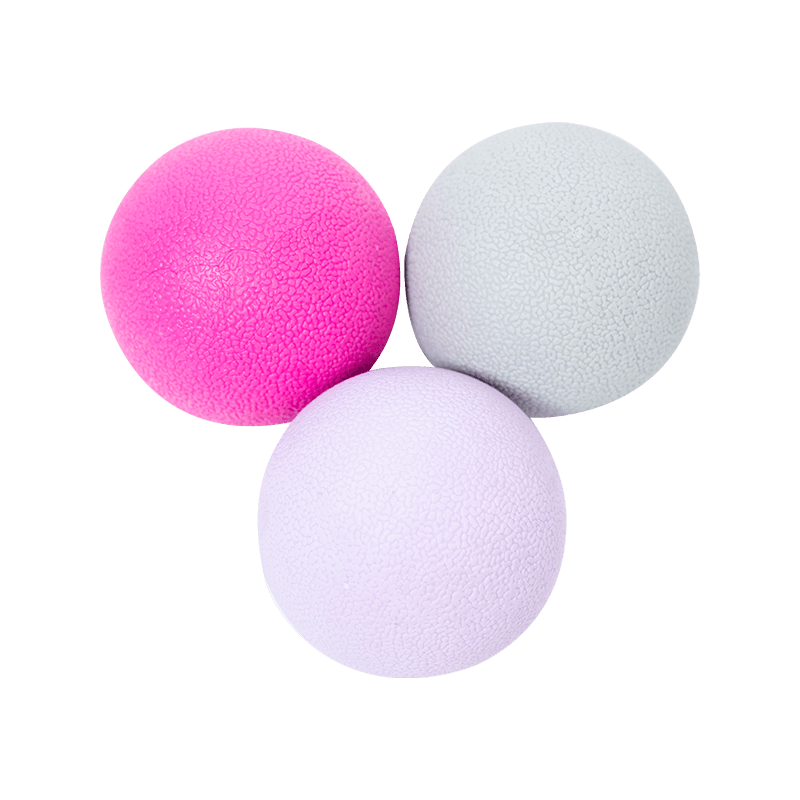
The market for fascia massage balls spans a wide range of materials, densities, surface textures, and sizes — each offering a distinct pressure profile and tissue response. Selecting the right type depends on target body region, sensitivity level, and intended use intensity.
Solid Rubber Massage Balls
Natural or synthetic rubber balls — typically lacrosse-ball sized at 60–65 mm diameter — are among the firmest options available and deliver deep, focused compression. Their non-porous, smooth surface maintains consistent pressure without deforming under body weight, making them effective for plantar fascia release, glute and piriformis work, and thoracic spine mobilization. The firmness of solid rubber makes it unsuitable for users with acute muscle soreness, injury, or low pain tolerance, as the pressure can feel intense even with partial body weight application.
EVA Foam Massage Balls
Ethylene-vinyl acetate (EVA) foam balls offer a softer, more compliant pressure profile than rubber. The closed-cell foam compresses slightly under load, distributing pressure across a wider contact area and reducing peak tissue loading. EVA balls are well-suited for beginners, for use on the neck and upper trapezius, and for restorative yoga sessions where sustained, gentle compression over several minutes is preferred over intense point loading. Their limited durability under repeated compression — progressive flattening over months of use — is the primary limitation relative to rubber or silicone alternatives.
Silicone Spiky Massage Balls
Silicone balls with molded surface spikes or nodules combine compression with mechanical stimulation of surface skin receptors, producing a sensory response that many users describe as more activating than smooth ball pressure. The spike geometry increases the effective surface contact area while the silicone compliance limits peak spike pressure — creating a firm but skin-friendly texture. Spiky massage balls are particularly effective for plantar fascia release (rolling underfoot while seated or standing), forearm flexor and extensor work, and scalp tension release. They are also widely used in pediatric sensory therapy and rehabilitation settings due to their tactile stimulation properties.
Peanut-Shaped Double Massage Balls
A peanut ball consists of two massage balls fused or enclosed in a single unit, creating a figure-eight shape that allows the spine or Achilles tendon to sit in the central channel while the two balls apply bilateral pressure on either side of the target structure. This geometry is particularly useful for thoracic spine extension mobilization, where placing the peanut ball under the mid-back and performing gentle extension allows segmental vertebral mobilization without direct spinal compression. Peanut balls are available in rubber, silicone, and EVA constructions at varying firmness levels.
| Type | Firmness | Best For | Suitable User Level |
|---|---|---|---|
| Solid rubber | High | Deep tissue, glutes, plantar fascia | Intermediate – Advanced |
| EVA foam | Low – Medium | Neck, upper back, beginners | Beginner – Intermediate |
| Silicone spiky | Medium | Plantar fascia, forearms, scalp | All levels |
| Peanut (double ball) | Medium – High | Thoracic spine, Achilles, bilateral work | Intermediate – Advanced |
Key Body Areas and How to Use a Fascia Massage Ball
Effective use of a yoga fascia massage ball requires positioning the ball under the target area, applying controlled body weight, and either holding static pressure on tender points (trigger point release) or performing slow oscillating movements to mobilize the tissue (myofascial rolling). The following body regions benefit most from targeted ball work.
Plantar Fascia and Foot
Place the ball under the arch of the foot while seated (partial weight) or standing (full weight). Slowly roll from heel to toe, pausing on areas of tension for 20–30 seconds. This technique is particularly effective for plantar fasciitis relief, morning foot stiffness, and preparation for standing yoga poses. A spiky silicone ball or a frozen water bottle can be used for additional anti-inflammatory effect in acute plantar fascia cases.
Glutes and Piriformis
Sit on the floor with the ball positioned under one glute, cross the ankle of the same side over the opposite knee (figure-four position), and slowly shift body weight to increase pressure into the piriformis and deep external rotators. This position targets the same muscle group released by Pigeon Pose in yoga and is highly effective for sciatic nerve tension, hip tightness from prolonged sitting, and preparation for deep hip-opening asanas.
Thoracic Spine and Upper Back
Place a peanut ball or two standard balls in a sock horizontally across the mid-back while lying supine, supporting the head with hands interlaced behind the neck. Allow gravity to extend the spine over the balls at each thoracic segment by moving the ball one vertebra at a time from T12 upward toward T1. This technique counteracts thoracic kyphosis from desk work and significantly improves chest opening capacity for backbend asanas including Camel, Wheel, and Fish Pose.
Shoulder and Pectoral Region
Position the ball between the chest wall and a vertical surface (wall or door frame) at the level of the pectoralis minor attachment — approximately one hand-width below the clavicle near the coracoid process. Lean body weight into the ball and make slow shoulder circumduction movements to work through the pec minor and anterior deltoid. Releasing this area improves shoulder external rotation and overhead mobility, directly benefiting Downward Dog, Chaturanga, and arm balance poses where pec minor tightness limits scapular posterior tilt.
Neck and Suboccipital Muscles
Lie supine with a soft EVA ball (never a firm rubber ball) positioned at the base of the skull, targeting the suboccipital muscles at the occiput-C1 junction. The weight of the head provides sufficient pressure without any additional load. Gentle yes-and-no head movements mobilize the atlantoaxial joint and release tension that commonly manifests as tension headaches, reduced cervical rotation, or referred pain into the temples. This technique should use only a soft or medium-density ball — firm balls applied to the suboccipital region carry a risk of excessive pressure on the vertebral artery.
Benefits of Regular Fascia Ball Practice
The evidence base for self-myofascial release using massage balls and rollers has grown substantially over the past decade. A consistent fascia ball practice delivers the following well-documented benefits when performed regularly as part of a yoga or fitness routine.
- Improved joint range of motion — acute increases in flexibility immediately following SMR are documented in multiple peer-reviewed studies; effects are most pronounced at the hip, ankle, and thoracic spine
- Reduced delayed onset muscle soreness (DOMS) — post-exercise rolling and ball work reduce perceived soreness at 24 and 48 hours post-training, likely through enhanced local circulation and fluid exchange in the tissue
- Trigger point deactivation — sustained ischemic compression on active myofascial trigger points reduces referred pain and local tenderness; 30–90 seconds of sustained pressure followed by active range of motion is the most commonly recommended protocol
- Enhanced body awareness and proprioception — slow, attentive ball work on the foot soles and hands activates mechanoreceptors and improves proprioceptive acuity in these regions, supporting balance and coordination in standing yoga postures
- Stress and tension reduction — parasympathetic activation associated with sustained, gentle pressure work on the body has a measurable calming effect on the autonomic nervous system, making fascia ball work a natural complement to restorative and yin yoga practice
What to Look for When Buying a Yoga Fascia Massage Ball
The quality and suitability of a fascia massage ball depends on several material and design factors that are not always evident from product images alone. The following specification points should guide selection for both individual consumers and wholesale or OEM buyers sourcing for retail or private label.
- Material safety and certifications — balls intended for skin contact should carry REACH compliance confirmation and be free of phthalates, BPA, and heavy metals; food-grade or medical-grade silicone is the preferred raw material for spiky silicone balls; look for SGS, RoHS, or CE certification documentation from suppliers
- Diameter and size options — standard sizes range from 55 mm (finger and forearm work) to 80 mm (glute and back work); a set of two or three sizes allows one product range to address the full body; confirm whether sizes are consistent with common body area recommendations in the target market
- Firmness / Shore hardness — for rubber or silicone balls, request Shore A hardness values from the supplier; typical ranges are 40–55 Shore A for medium-firmness balls and 60–75 Shore A for firm balls; EVA foam density (kg/m³) serves a similar comparative function for foam products
- Surface texture and grip — smooth balls should have sufficient surface friction to prevent slipping on yoga mat surfaces; spiky balls should have nodule geometry that delivers stimulation without skin abrasion at normal body weight pressure
- Odor — low-quality rubber or EVA materials often carry a strong chemical odor that does not dissipate quickly; request pre-shipment samples and assess odor level before confirming wholesale orders, particularly for yoga and wellness retail where customer product experience is brand-sensitive
- Packaging and branding options — for OEM and private label buyers, confirm minimum order quantities (MOQ) for custom packaging, color options, and printed branding; mesh drawstring bags, retail hang tags, and instructional insert cards are common value-add packaging elements in the yoga accessories segment