

 English
 日本語
 Español

A fitness distributor adding grip rings to a private-label catalog will quickly discover that the category has no uniform resistance standard. Two rings with the same printed load can differ in measured force by more than 30 percent. That makes sourcing a product-liability question as much as a price negotiation, which is why responsible buyers spend as much time on test data as on color and packaging.
Grip Rings Train Closing and Opening Strength in One Tool
A grip ring is a circular resistance tool, usually molded from TPE or wound from spring steel, that loads the finger flexors as you squeeze and the extensors as the ring reopens.
Unlike a hinged hand gripper, which isolates crushing force and neglects extension, a ring distributes pressure across all four fingers and lets you push outward against the inside edge. That coverage is why grip rings appear in training programs for climbers, tennis players, golfers, cyclists, and rehabilitation patients, and why they belong in the same retail family as other hand-strength training equipment.
- Whole-hand squeeze trains the finger flexors and the forearm.
- Pushing outward against the ring trains the extensors, which most grip tools ignore.
- The open center keeps the wrist neutral and removes hinge pinch points.
- No moving parts means nothing to adjust, lubricate, or replace.
Definition: a grip ring produces resistance through elastic deformation of the loop itself. The force curve, not the printed number, decides whether a ring is safe and effective for a given user.
Match Ring Resistance to User Level, Not the Label
Resistance labels on grip rings are not standardized, so the printed number says little until you verify the force at a defined deflection.
Ask a supplier for a force reading at 20 mm of squeeze, and you will separate factories that measure from factories that print. The ranges below are typical across the market, but treat them as starting points, not finished specifications.
| User level | Resistance (lb) | Typical material | Best use case |
| Rehabilitation | 15-25 | Soft TPE | Post-injury mobility and arthritis-friendly routines |
| Beginner | 25-40 | TPE or coated steel | General fitness and desk workers |
| General fitness | 40-60 | TPE or PU-coated spring steel | Strength maintenance and recreational sports |
| Athletic | 60-90 | Spring steel, thick wall | Climbing, wrestling, and grip sports |
| Professional | 90-120 | Stacked rings or high-rate steel | Competition preparation and advanced programming |
To reproduce a ring SKU across production batches, specify three numbers: force at 10 mm deflection, force at 20 mm deflection, and outer diameter. These values let the factory hold a consistent product and let your customers compare rings honestly.
Ring Material Sets Durability, Feel, and Compliance
The material of a grip ring determines how the force builds, how many cycles it survives, and which compliance documents your importers will request.
TPE and elastomer rings
TPE rings dominate rehab and beginner lines because they feel smooth, flex quietly, and cost less. The trade-off is material memory: with a poor compression set, a heavily used ring stays visibly oval after a few weeks. A quality TPE compound holds its shape beyond 10,000 compression cycles.
Spring steel rings
Steel rings deliver a consistent force curve and a long fatigue life, which is why advanced athletes prefer them. They need a bonded sleeve or a coated edge, otherwise the hard surface becomes uncomfortable at high loads.
Coated and composite rings
PU-coated steel cores combine comfort with durability, but the coating bond is the weak point. Ask for a cross-cut adhesion test and a minimum bend radius in the spec sheet.
- Shore A hardness tolerance of plus or minus 3 points for elastomer rings.
- Compression set below 15 percent after 24 hours at 40 degrees C.
- Cross-cut coating adhesion test for steel-core rings.
- No surface cracking after 5,000 full-deflection cycles.
Skin-contact check: a ring that is mostly TPE still depends on its color masterbatch. Confirm the pigment is rated for repeated skin contact, or a bright custom color can become a compliance problem later.
Build a Six-Week Progression That Makes the Ring Indispensable
Eight to twelve controlled repetitions per set, repeated two to three times, is the effective core of grip ring training, and a six-week progression gives users a reason to keep the ring in rotation.
Start with mobility, build strength, then add speed. This progression is simple enough to print on packaging, which makes it useful for retail inserts and brand content.
- Full-palm squeeze: close the ring slowly without locking the knuckles; hold for two seconds.
- Finger extension: place the fingers inside the ring and push outward against the inner surface.
- Single-finger press: hold the ring in the palm and press with each fingertip from index to little finger.
- Thumb opposition: squeeze the ring between the thumb and each finger in sequence.
- Stacked-ring squeeze: use two rings together once the single ring no longer challenges you.
Progress rule: move up in resistance only after completing three sets of twelve with full control. The most common error is increasing load too early, which shifts strain to the finger joints.
What to Verify Before Placing a Private-Label Grip Ring Order
A serious grip ring supplier hands over measured performance data, material documentation, and a clear tolerance policy before production starts.
Because the market has no common standard, the purchase order is where you create one. Each resistance SKU should reference a target force at a defined deflection, and incoming inspection should repeat that measurement on samples.
- Force-deflection curve per resistance level and per raw material batch.
- Outer diameter and wall thickness tolerance of plus or minus 0.5 mm.
- Color stability under UV exposure and no pigment transfer to skin.
- MOQ breakdown by color, resistance, and packaging option.
- Packaging formats: polybag, hangtag, retail box, or bulk carton.
- REACH, RoHS, and Proposition 65 test reports.
A factory that molds its own elastomer components keeps these variables under one roof. Suzhou Apex Sports Goods Co., Ltd., in Zhangjiagang, has produced TPE and EVA fitness products since 2015 and exports to North America, Japan, South Korea, Germany, and Vietnam. Its TPE molding line can handle ring tooling, custom durometer, and color matching.
Many buyers who stock grip rings add a molded grip ball to the same program, so both tools share packaging, colors, and compliance files across one supply contract.
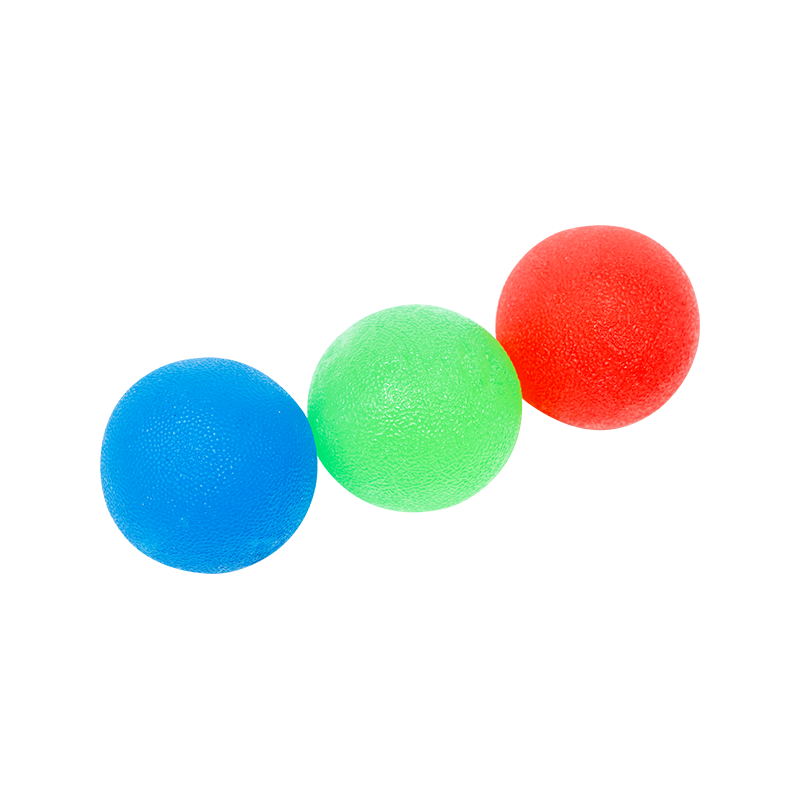 TPR Standard Round Grip Training Ball for Hand StrengtheningThis 50 mm TPR grip ball weighs 55 g and offers even resistance to build hand and finger endurance. Its textured surface prevents slipping, making it suitable for office relaxation, rehab, or climbers and musicians.View Product →
To turn your target-force specifications into a manufacturable product, the export team at Suzhou Apex can discuss your OEM and ODM requirements directly and arrange pre-production samples.
Sourcing expectation: a mature TPE molder can return ring samples in two to three weeks, including durometer and color matching. Ask for a sample sheet with measured force values before approving tooling.
Grip Ring FAQ
What resistance should a beginner start with?
Beginners should start in the 25-40 lb band for general fitness and 15-25 lb for rehabilitation. If the supplier cannot verify the force, choose a soft TPE ring that compresses noticeably within a 15-20 mm squeeze.
Are grip rings better than traditional hand grippers?
Not better, different. Hinged grippers isolate crushing strength; grip rings cover closing and opening strength in one movement. Serious hand-training programs use both, and rings are easier on the wrist because they keep it in a neutral position.
How long does a quality grip ring last?
A well-made TPE ring should exceed 10,000 compression cycles without permanent deformation, and steel-core rings last considerably longer. Replace a ring when it stays oval after release or develops surface cracks.
Can grip rings support injury recovery?
Yes, with limits: low-resistance rings support gentle mobility and blood flow, but strength work after an injury should be cleared by a clinician first.
Key takeaway: the ring is the tool, but the spec is the product. Buyers who verify force, material, and compliance build a hand-strength line that sells once and repeats.